


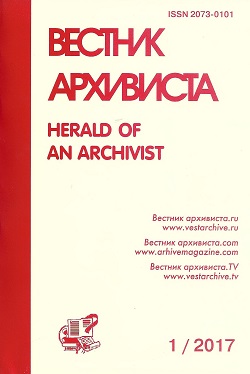







Funds of the State Archive of the Republic of Tatarstan as a Source for Church-Historical Вeviance of the Second Half of the 19th – Early 20th Centuries


Scientific article
DOI 10.28995/2073-0101-2026-3-725-741
For citation
Khokhlov, A. A. (2026). Funds of the State Archive of the Republic of Tatarstan as a Source for Church-Historical Вeviance of the Second Half of the 19th – Early 20th Centuries, Herald of an Archivist, no. 3, pp. 725-741. DOI 10.28995/2073-0101-2026-3-725-741
Khokhlov, A. A., Kazan Federal University, Kazan, Russia
Funds of the State Archive of the Republic of Tatarstan as a Source for Church-Historical Вeviance of the Second Half of the 19th – Early 20th Centuries
Abstract
The article purposes to review materials from the State Archive of the Republic of Tatarstan (GART) in order to identify sources on church-historical deviance – a field of contemporary historical research that addresses moral and legal deviations within the social sphere of the Russian Orthodox Church (ROC), including clergy, clergy members, and parishioners. In this case, the author focuses on documents from the post-reform period. The article notes that interest in the problem of clerical morals has always been characteristic of Russian historiography; however, only in recent decades, due to a significant expansion of the scope of scholarly research and a softening of ideological attitudes it has become possible to access freely, analyze, and interpret relevant archival materials. The author's study of the GART collections in recent years has uncovered a significant body of documents of considerable interest in terms of deviance within a religious context. This opens up new heuristic perspectives in the field of church historiography. First and foremost, this concerns Fund No. 4 of the Kazan Spiritual Consistory (KSC GART), which houses a wealth of unique and at the same time ethically controversial information. The selected period alone is represented by three hundred investigative cases initiated by ecclesiastical authorities against the parish clergy of the Kazan Diocese. It is clear that an objective interpretation of this information is only possible with due regard for the historical context in which the documents were created. Therefore, the analysis conducted in this article appropriately takes this historical context into account. The collection of cases is given a general overview, the author's typology is presented, their informational capacity is outlined, and their internal structure, semantic, stylistic, and other features are defined. The KSC GART funds have not previously been a specific object of study for historians. Therefore, the overwhelming majority of the documents stored within possess heuristic novelty and originality. This allows us to significantly expand our understanding of the socio-normative culture of the Orthodox Church at the turn of the 19th and 20th centuries including its microhistorical and everyday aspects. Thus, the introduction of this layer of identified sources into scholarly circulation is from a scientific perspective an important result and the comprehensive analysis of the documents positively complements the relevant areas of source studies raising the issue of similar archival research outside the Republic of Tatarstan.
Keywords
Church, history of the Russian Church, clerics, clergy, parish, spiritual consistory, church-historical deviance, social deviations, Orthodox parish clergy, archive, fund, source.
Download the article: khokhlov_doi
References
Bernshtam, T. A. (2005). Parish Life in the Russian Village, Essays on Church Ethnography, St. Petersburg, Petersburg Oriental Studies publ., 416 p.
Venediktov, D. G. (1933). Executioners in Cassocks, The Past of the Russian Clergy, Leningrad, Loiz publ., 175 p.
Gaidenko, P. I. (2016). Everyday Life and Customs of Bishops and Their Flock in Kievan Rus', 11th–13th Centuries, St. Petersburg, O. Abyshko publ., 253 p.
Grekulov, E. F. (2011). Customs of the Russian Clergy, St. Petersburg, Nevzorov Haute Ecole publ., 48 p.
Golubinsky, E. E. (1913). On the Reform in the Life of the Russian Church, Moscow, Imperial Society of Russian History and Antiquities at Moscow University publ., 132 p.
Znamensky, P. V. (1873). Parish Clergy in Russia since the Time of Peter the Great's Reform, Kazan, University publ., 855 p.
Karamzin, N. M. (1991). Note on Ancient and Modern Russia in Its Political and Civil Relations, Moscow, Nauka publ., 127 p.
Klyuchevsky, V. O. (1969). The Church and Russia, Paris, YMKA-press publ., 89 p.
Klyuchevsky, V. O. (1990). Diary Entries from 1902–1911. In: Works, vol. IX, Proceedings from Different Years, Moscow, Mysl' publ., pp. 267–362.
Korshunkov, V. A. (2018). Crimes and Punishments of the Sexton Zamyatin, as in the 19th Century, the leadership of the Vyatka diocese re-educated their subordinates, Document. Archive. History. Modernity, iss 18, pp. 66–67.
Leontyeva, T. G. (1997). Everyday life, customs, and behavior of seminarians at the beginning of the 20th century. IN: Revolution and Man, Everyday life, customs, behavior, morals, Proceedings of the All-Russian Scientific Conference, Moscow, November 14-15, 1995, Ed. P. V. Volobuev, Moscow, Institute of Russian History of the Russian Academy of Sciences publ., pp. 20–38.
Platonov, S. F. (1993). Lectures on Russian history, Moscow: Vysshaya shkola publ., 736 p.
Pulkin, M. V. (2008). Deviant behavior in the 18th – early 20th centuries, based on materials from the Olonets province, Cultural-historical psychology, no. 2, pp. 84–90.
Romanov, B. A. (2013). People and customs of Ancient Rus', Moscow, Lomonosov publ., 224 p.
Smolich, I. K. (1996). History of the Russian Church, 1700–1917, bk. 8, pt. 1, Moscow, Spaso-Preobrazhensky Valaam Monastery publ., 798 p.
Soloviev, S. M. (1989). Readings and Stories on the History of Russia, Moscow, Pravda publ., 768 p.
Fedorov, S. G. Neupokoev, I. V. (2025). Deviant Behavior of the Rural Clergy and Its Influence on the Peasant Community in the Second Half of the 19th – Early 20th Century, using the Tobolsk Province as an Example, Tomsk State University Journal of History, no. 93, pp. 103–112.
Fot, A. G. (2014). Non-canonical behavior and counter-sanctions among the Orthodox parish clergy, on the materials of the Orenburg diocese, The Privolzhsky Scientific Journal, no. 9 (37), pp. 44–51.
Kharin, E. S. (2015). Everyday life and customs of ancient Russian monasticism in the 11th–13th centuries, Izhevsk, Udmurt University publ., 248 p.
Beer, D. (2004). The Medicalization of Religious Deviance in the Russian Orthodox Church, 1880–1905, Kritika, Explorations in Russian and Eurasian History 5, 3, Summer 2004, pp. 451–482.
Belliustin, I. S. (1985). A Description of the Clergy in Rural Russia, The Memoir of a Nineteenth-Century Parish Priest, transl. with introduction and interp. essay by G. Freeze, Ithaca, Cornell University publ., 224 p.
Durkheim, Е. (1975). Textes, 2, Religion, morale, anomie, Paris, Les ?ditions de Minuit publ., 508 p.
Freeze, G. L. (1977). The Russian Levites, Parish Clergy in the Eighteenth Century. IN: Russian Research Center Series, vol. 78, Cambridge, Harvard University publ., 352 p.
Freeze, G. L. (1983). Parish Clergy in Nineteenth-Century Russia, Crisis, Reform, Counter-Reform. Princeton, Princeton University publ., 552 p.
Freeze, G. L. (1999). Church and Politics in Late Imperial Russia, Crisis and Radicalization of the Orthodox Clergy, Russia under the Last Tsar, Opposition and Subversion, 1894–1917, Oxford, Blackwells publ., pp. 269–297.
About authors
Khokhlov Alexander Anatolyevich, Doctor of Historical Sciences, Associate Professor, Kazan Federal University, Institute of International Relations, History and Oriental Studies, Department of History of Tatarstan, Anthropology and Ethnography, Associate Professor, Kazan, Russia, +7-843-233-71-09, +7-987-2-36-45-36, This e-mail address is being protected from spambots. You need JavaScript enabled to view it
ORCID 0000-0003-2920-0287
The article was received in the editorial office on 27.04.2025, recommended for publication on 20.06.2026